
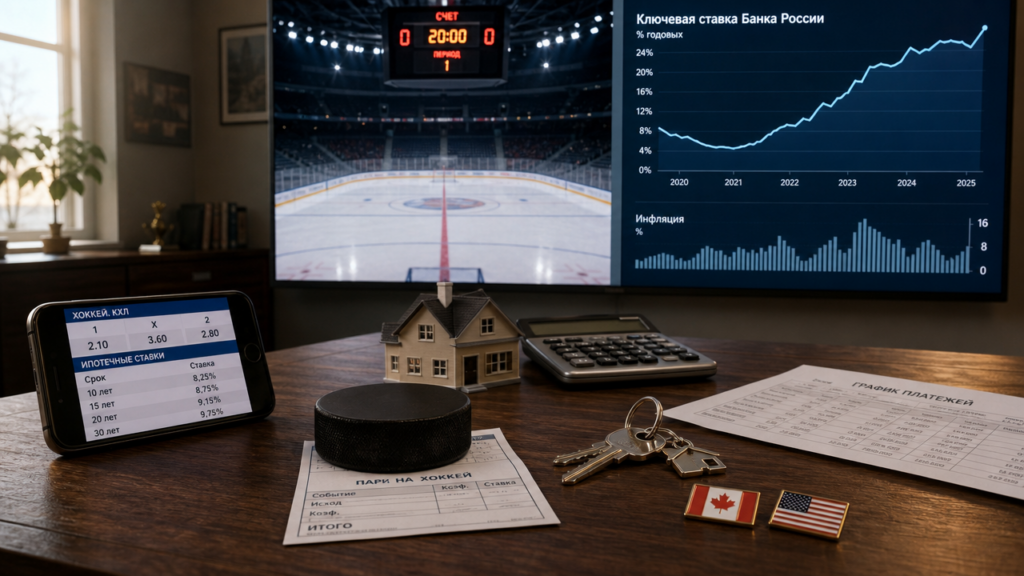
The Canadian central bank held its overnight rate at 2.25% in September 2026, while Canada faces the USA at a -1.5 handicap priced at 1.70. One figure shapes borrowing conditions; the other reflects a high-scoring hockey wager.
Canada-US Betting Line and the Over 5.5 Case
Canada won Group B and now faces the USA, its main rival. At -1.5, Canada must win by two or more goals for the ticket to cash. The 1.70 price implies a 58.8% break-even probability, while a one-goal victory would leave the handicap bet unsuccessful.
Both teams often produce games above 5.5 goals, and their defenses have shown weaknesses. Historical meetings average 5.8 goals, making the over an attractive option despite the public preference for high-scoring markets. Canada also has a revenge angle and should approach the derby with strong motivation.
Canada-US Rates and the 2.25% Anchor
Canada-US rate comparisons matter for mortgage pricing. Rising bond yields push fixed mortgage rates higher, while banks can reduce discounts on floating rates to protect their margins. The Canadian central bank kept its overnight rate at 2.25% in September 2026.
The bank cited higher inflation risks linked to the war in the Middle East and potential tariffs, although underlying inflation remained on target. Economic resilience and current uncertainty prevented a clear policy signal.
The rate remains moderate by historical standards. Canada’s overnight rate reached 16% in 1991 and fell to 0.25% in 2009. The central bank was founded in 1934 and became state-owned in 1938. It manages the Canadian dollar and targets 2% inflation.
Canada Mortgage Rate and Down Payment Math
Floating Canada mortgage rates ranged from 3.5% to 4.0% in April 2026, below fixed rates. The required down payment depends on the purchase price:
- Below $500,000: 5%.
- From $500,000 to $1 million: 5% on the first $500,000 and 10% on the remainder.
- Above $1 million: 20%.
Closing costs are separate from the down payment. The funds must be owned savings held for at least 90 days. Loan approval also depends on income, existing debt, and debt-service ratios. The maximum GDS ratio is 32%, while the maximum TDS ratio is 40%.
Down payments below 20% require mortgage insurance. Premiums range from 0.6% to 4.5% and protect the lender. Conventional mortgages require at least 20% down and do not require this insurance.
Fixed vs Floating Canada Mortgage Rate
Floating rates were lower than fixed rates in April 2026, but global instability was pushing borrowing costs higher. Rising bond yields increased pressure on fixed rates, while lenders reduced floating-rate discounts to protect margins.
A mortgage is generally repaid through monthly payments over 25 to 30 years. It is registered against the property and may be transferable. A down payment is required, and borrowers should account for closing costs, insurance, income, and existing debt before committing to a payment.