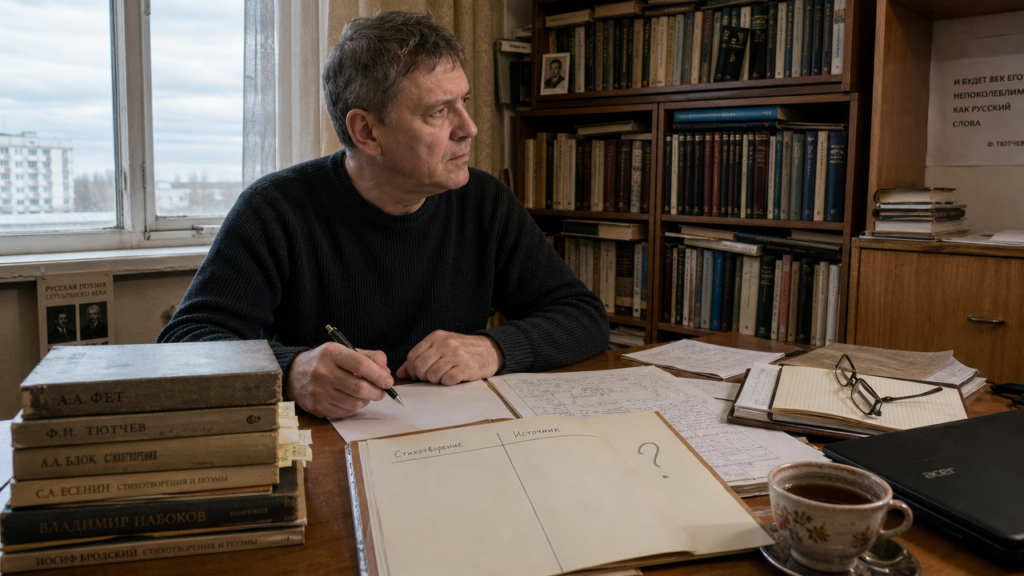
This is not a card, but the same rule applies: no primary text, no reliable comparison. The requested analysis of Sergei Skachko’s poetry versus Sapgir cannot begin because the supplied references contain no primary Skachko text. They contain zero Skachko poems, zero collection titles, and zero publication years. The references also provide no primary poems or verified biographical details for Sapgir. A serious comparison needs a defined corpus from both poets.
What the Supplied Sources Establish
The surname Skachko appears in Source 11, but that reference names Lidiya Skachko, an official at a Belarusian music academy, not a poet. No supplied source lists Sergei Skachko’s dates, city, verse collection, or sample lines. That unrelated reference cannot serve as literary evidence.
Source 4 describes a Moscow museum’s 1862 move from St. Petersburg. Source 10 describes a 170-participant student conference with 88 speakers. Source 12 reports that 95.4% of surveyed respondents opposed making remote learning permanent. None of these documents discusses Sergei Skachko’s poetry or Sapgir.
A Framework for Comparison
A useful comparison requires counting features rather than relying on general impressions. The table below lists four tests that can be applied once primary texts by both poets are available.
| Test | What to examine in Sapgir | What to examine in Skachko |
|---|---|---|
| Line length | Measure the syllable range and enjambment in a defined sample | Use the same sample size and method |
| Sound work | Track alliteration, assonance, and puns | Record the same sound patterns |
| Register | Classify shifts between colloquial, formal, and figurative language | Apply the same vocabulary categories |
| Publication path | Verify the date and venue of each text’s first publication | Check the date and venue of the first printed poem |
The table turns a broad literary judgment into a checkable method. If one poet averages 12 syllables per line and the other averages 5, their rhythmic profiles differ. If both average about 6 syllables per line, the comparison has a stronger formal basis. These figures are hypothetical until a verified corpus is assembled.
How to Read the Form Without Overstating the Evidence
A reader should collect 10 poems by each poet and mark line breaks, figurative language, and topic shifts. Counting those features turns a broad comparison into a checkable dataset. For example, a sample of 20 lines from one poet might show one tone shift, while a matching sample from the other might show four. That difference could support a stylistic observation, provided the samples are comparable.
The value of comparing Sergei Skachko with Sapgir would lie in examining sound, rhythm, imagery, and publication history. Without primary texts, however, no responsible claim can be made about either poet’s distinctive technique. A shared surname or an unrelated music-academy reference is not literary evidence.
Evidence Needed for a Full Analysis
A reliable comparison requires at least five poem titles, one collection name, and a sample of 20 lines from each poet. Until those materials are supplied, the evidence supports only a research framework, not a conclusion about their poetic styles.