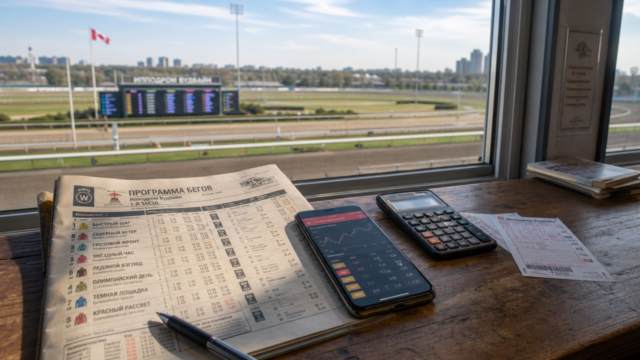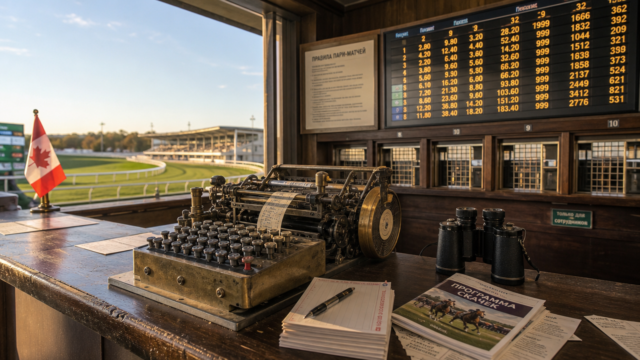
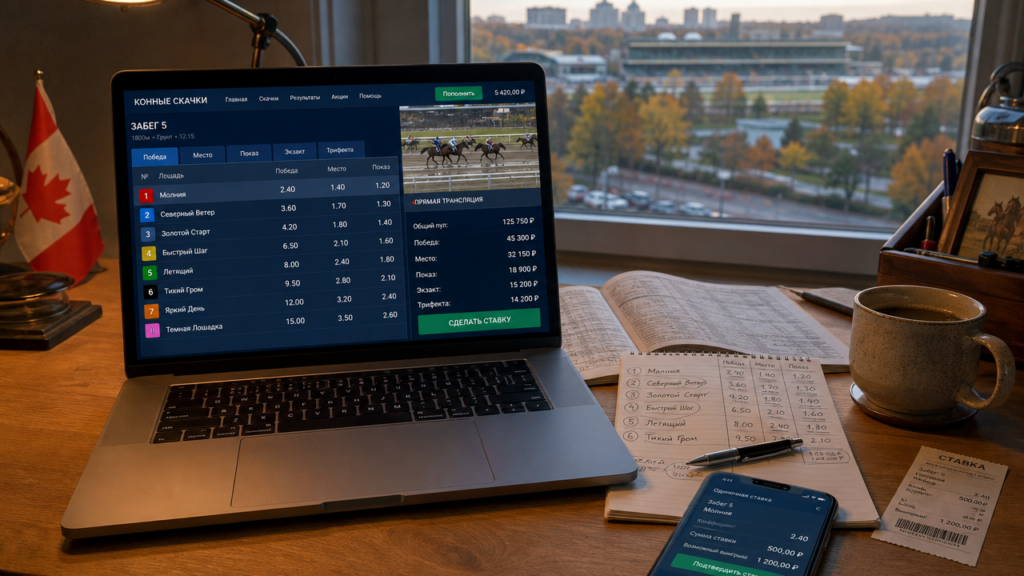
Online horse racing betting in Canada is built on pari-mutuel pools, so the tote determines every payoff. A $2 win ticket on a horse paying $9.40 returns $9.40 total, a $7.40 profit, but the price can shift before the gate opens. Licensed online betting operators give Canadian players access to the same core markets available at the track, including win, place, show, exacta and trifecta pools.
Use a model six-furlong race with several evenly matched runners. When the field includes a clear favorite and a few credible alternatives, the main task is deciding whether the favorite offers enough value for a straight bet or works better in a combination.
Win, Place and Show in a Sprint
A win ticket pays only if the horse finishes first, and the payout is highest when the public ignores a live runner. A $10 win bet at 4-1 returns $50 total, a $40 profit. Place and show require a top-two or top-three finish, but the prices compress when a heavy favorite runs up the board. A short-priced winner can also force a third choice to produce a small show return.
Show betting carries less risk of finishing outside the money, but the return is usually lower. Compare the price with the risk before placing the ticket, and avoid relying on a favorite simply because it is likely to finish near the front. Bankroll efficiency starts with setting a stake limit and choosing prices that justify the risk.
Each-way betting combines a win bet with a place bet, so the stake is doubled. The place portion pays a fraction of the win odds, commonly one-quarter or one-fifth, depending on the rules of the race and operator.
Exacta and Trifecta Key Tickets
A $3 exacta key placing horse 2 over horses 1, 4 and 7 costs $9. It wins if horse 2 finishes first and one of the three selected runners finishes second. A $1 trifecta key placing horse 2 first, horses 1 and 4 second, and horses 1, 4 and 7 third costs $6, because the second position has two selections and the third position has three.
A key ticket keeps costs down while putting the strongest opinion on top. Forecast bets cover the first two finishers, either in the predicted order or in reverse order. Tricast bets cover the first three finishers, with the number of combinations increasing quickly as more runners are added.
Reading the Race Card
Start with recent form, age, weight, jockey, race distance and the horse’s expected pace style. Younger horses may suit shorter races, while experienced runners can be better suited to longer distances. Rest periods and the surface also matter when comparing otherwise similar runners.
A front-runner may benefit from an uncontested lead, while several speed horses can create a faster pace for a closer. The best selection is not always the shortest-priced runner. Compare the horse’s recent performances with the odds, then decide whether the value lies in a win, place, show, exacta or trifecta market.
A $40 Online Horse Racing Betting Plan
Set a $40 ceiling before placing any bets. One balanced plan is a $10 win bet on the strongest selection, a $6 show bet if the price is at least 4-1, a $3 exacta key with that horse over three alternatives, and a $1 trifecta key using two runners in second and three in third. That totals $31, leaving $9 unspent unless the odds offer better value.
If the selection drifts to a higher price, increasing the win stake may be reasonable. If the price falls sharply, skip or reduce the win bet and reconsider the combination tickets. A short price does not remove the risk of a poor start, an unsuitable pace or a late-running outsider.
Other approaches include the Trixie, which combines three selections into three doubles and one treble. With three favorites priced at 2.00 or higher, two winning selections return the stake in the stated strategy. Another approach backs favorites with relatively high odds, around 4.00, across multiple races. Neither method removes the need for careful selection and bankroll control.
No ticket construction removes the chance of an unexpected result after a pace collapse. Keep the bankroll fixed, use one key horse per race, and treat a losing ticket as part of the cost of testing a disciplined betting plan.