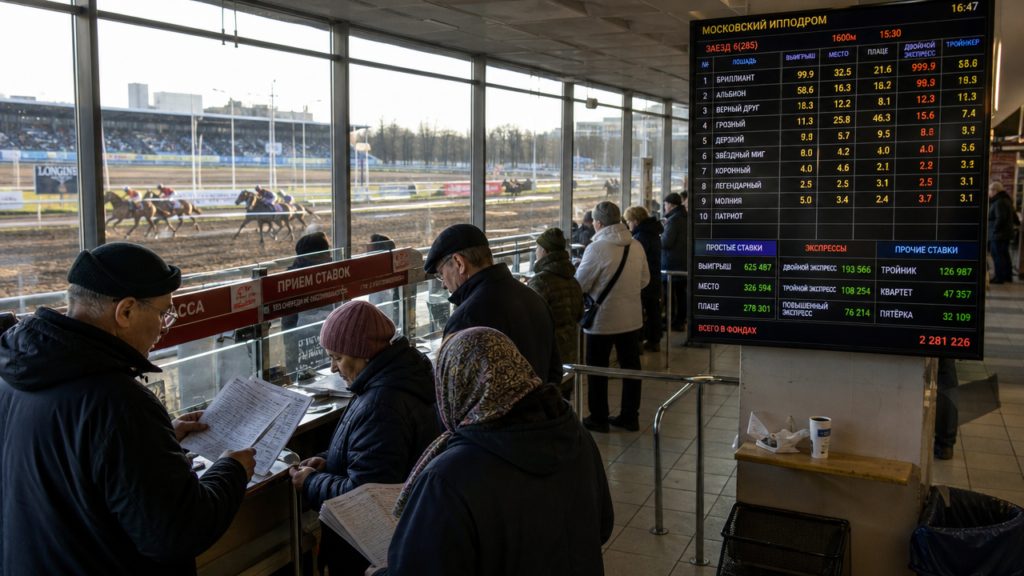
Konayev racetrack estimates that each horse supports about 8 jobs, and the global racing industry stages roughly 140,000 races a year with about 3 billion EUR in prize money. The betting side turns over approximately 106 billion EUR annually, led by Japan and the USA. For Canadian players, that scale matters because a hippodrome with betting pools win, place, show, exacta and trifecta wagers from every terminal into one totalizator system. A Woodbine win bet and a Ramenskoye Hippodrome win bet use the same core logic: the track takes a commission from the pool, and the remaining money is split among all winning tickets.
At a hippodrome with betting, you are not playing against a fixed-odds sportsbook. A bookmaker accepts fixed-odds bets, while a totalizator pools every wager and pays out after takeout. Ramenskoye Hippodrome accepts bets at the hippodrome through an official totalizator that dates to the reopened plant in 1982, following an eight-year reconstruction under Isa Karaev. Kazan Hippodrome betting and Barnaul Hippodrome official horse racing betting sit in the same Russian hippodrome directory, meaning you are betting into a pool, not against a bookmaker ticket. Canadian fans using an advance deposit wagering account should confirm that a foreign operator is licensed in its home jurisdiction before depositing.
Win, Place and Show: The Cash Pools
A win bet pays only when your horse finishes first. A place bet pays when the horse finishes first or second. A show bet pays when the horse finishes first, second, or third. At Canadian tracks, a $2 win ticket is the standard starting point, while a $2 show ticket on a 2-5 favorite can pay as little as $2.10.
The table below compares the five core wagers for a Canadian race fan.
| Bet Type | Finish Condition | Example Cost | Best Use |
|---|---|---|---|
| Win | First only | $2 | Strong opinion at 3-1 or higher |
| Place | First or second | $2 | Closer at 6-1 who may settle for second |
| Show | First, second, or third | $2 | Rarely, when a longshot has hidden late pace |
| Exacta | First two in exact order | $2 straight, $4 box | Two-horse race with a pace setup |
| Trifecta | First three in exact order | $1 part-wheel or $0.20 base | Key horse plus two underneath runners |
Win, Place, Show Tips for Woodbine Cards
Do not use show bets as a default on a short-priced favorite. A $2 show ticket on a 2-5 favorite returning $2.10 pays a 5 percent profit, which does not compensate for a bad trip or a speed duel. A better show target is a 10-1 runner with a strong late pace figure who might pass tired speed to finish third at a payout of $6.00 to $8.00.
For a 6 1/2-furlong Tapeta sprint at Woodbine, watch the opening quarter. If two frontrunners draw posts 1 and 2, a stalker from post 5 with a recent Equibase figure of 90 or higher is a stronger win-place candidate than the inside speed. A $20 win bet at 4-1 returns $100 if that stalker wins, while a $10 place bet can return $30 to $40 if he settles for second.
Exacta Strategy: Key a Late Runner, Not the Favorite
An exacta demands the first two finishers in order. At a $2 base, a straight #7 over #4 ticket costs $2. Boxing #7 and #4 costs $4, since it covers both possible orders. If #7 Maple Crown is 5-1 and has recorded three straight late pace figures above 90, keying him on top over #2, #4, and #9 costs $6 at a $2 base. The ticket reads 7 / 2,4,9.
At Woodbine, the terminal may label an exacta as an Exactor and a trifecta as a Triactor. A $2 Exactor 7-4 is the same as a $2 exacta with 7 first and 4 second. Do not key a 2-1 favorite in that exacta. When the public’s top pick wins, the exacta pool is compressed by heavy combination wagering. A $2 exacta with a 5-1 winner over a 6-1 runner often pays $80 to $140, while the same two runners with the favorite on top may pay $30 to $50.
Trifecta Strategy: Use a Part-Wheel With a Price Horse
A trifecta requires the first three in exact order. A $1 trifecta part-wheel of #7 Maple Crown over #2, #4, #9 over #2, #4, #9 costs $6 because it covers 1 x 3 x 2 combinations. At a $0.20 triactor base at some Canadian tracks, the same part-wheel costs $1.20, which lets you afford a second ticket.
Use a trifecta when two pace factors align. In a 7-furlong race at Woodbine with a contested 22.1 opening quarter, the leaders can fade inside the final sixteenth. A closer with a 94 late figure and a price of 8-1 becomes the key horse. Put that runner first and second in two separate part-wheels: #8 / #2,#5,#7 / #2,#5,#7 and #2,#5,#7 / #8 / #2,#5,#7. At $1 each, the combined cost is $12.
Bankroll Management for a Hippodrome Card
Set a card budget before post time. A $40 plan can be split as $16 on win-place for your strongest opinion, $12 on one exacta key, and $12 on two trifecta part-wheels. That structure limits losses when the card runs against you. The takeout percentage for each pool is printed on the Woodbine program or self-serve screen, so read it before pressing the button.
International hippodromes that accept wagers use the same pool mechanics. Kazan Hippodrome betting, Barnaul Hippodrome official horse racing betting, and Ramenskoye Hippodrome betting are not fixed-odds bookmaker platforms. They are totalizator pools where the takeout percentage controls the payout. Ramenskoye offers trotting tests on Saturdays and Friday summer cards with free entry and an official totalizator. Canadian fans should read the takeout sheet before comparing a foreign pool to a Woodbine pool.
Totalizator payouts are observable, but trip and pace still decide the cash. Bet the pools with a key horse, not a blanket spread, and size the ticket so a losing race costs less than a winning one pays.